
 0
0  0
0 The World Bank-supported Climate Adaptation and Resilience for South Asia (CARE) project, implemented by the Asian Disaster Preparedness Center (ADPC), has been empowering decision-makers with tools, products, and services to act locally on climate-sensitive sectors such as agriculture, water, and transportation. As part of its CARE initiative, ADPC launched interventions to create an enabling environment for climate resilience in South Asia by improving the availability of regional data and knowledge; developing guidelines, tools, and capacities; and promoting climate-resilient decisions, policies, and investments across key sectors.
The project enabled crowdsourcing of innovators and developers of disruptive technological solutions that are need-based and tailored to the challenges faced by the region. Building on this momentum, a third round of innovations for Climate Adaptation and Resilience (iCARE) was proposed for 2023–2025. ADPC launched this third phase to pilot new innovations and scale up previously tested solutions. The initiative aims to promote innovation and co-creation in climate resilience data and analytics, foster the use of decision-support systems for climate resilience, and advance climate-resilient development across select sectors. Collectively, the three rounds of iCARE innovations have made a remarkable impact, reaching more than a million citizens and around 40 governments in just four years.
Harnessing Technology for Early Warning and Disaster Preparedness
TechEmerge Resilience India Challenge (2020–2022) was launched by the World Bank in consultation with the National Disaster Management Authority (NDMA), India, and International Finance Corporation (IFC) as a technical partner to crowdsource private-sector expertise and market-based innovation. Specifically, it has enabled crowd-sourcing innovators and developers of disruptive technological solutions that are need-based and matched to the challenges faced by the country. The main objective of the initiative was to enhance the capacity of the communities and State Disaster Management Authorities (SDMAs) to prepare and respond to disasters, climate risks, and COVID-19, through cutting-edge technological interventions.
ADPC successfully catered and implemented 7 innovations in India through the TechEmerge Resilience India Challenge:
- “Flood Forecasting System” piloted in Chamba, Himachal Pradesh, India by Nelen & Schuurmans.
- “AI-based real-time Earthquake Early Warning System (EEWS)” piloted and deployed in the state of Uttarakhand, India by Seismic AI.
- “Emergency Communication Network using DuckLinks” piloted in Himachal Pradesh, India by Project OWL.
- “Unmanned Aerial System for Disaster Preparedness, Response & Relief” piloted and implemented in coordination with the State Disaster Management Authority of Himachal Pradesh, India by IdeaForge.
- “Community-Driven Radio (CDR) through open source technology” piloted in 16 remote communities in Uttarakhand state in India by Pragathi Foundation.
- “Self-propelled Self-steerable Lifebuoy for Flood Rescue” piloted in Himachal Pradesh, India by Saif Seas.
- “Incident Management and Reporting System” piloted and implemented across 12 districts in Himachal Pradesh State, India by Quantela.
Building Resilience through Agriculture, Infrastructure, and Water Solutions
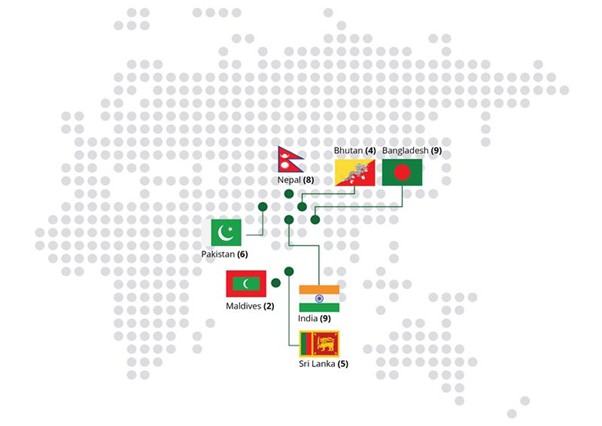
Climate Innovation Challenge (2021–2023), launched by ADPC with the World Bank and FCDO, aimed to crowdsource innovative and disruptive technology solutions from around the world for resilience in South Asia. Through grant awards, matchmaking, and pilot-testing, CIC facilitated about 16 different innovations across various sectors at national, sub-national, and local/community levels.
These included:
- Customized Irrigation and Climate Advisory Services in Pakistan, by Pakistan Council of Research in Water Resources (PCRWR).
- Tidal River Water Custodian in Bangladesh, by Carthago Consultancy BV.
- Infrastructure Vulnerability to Slope Instabilities and Floods in Bhutan, by Geoneon Private Limited.
- Sustainable Agriculture Technology (SAT) in Pakistan, by Pro Nature Alliance Research & Development Pvt. Ltd.
- ADOPT Model for Technology Diffusion in Bangladesh, by Curtin University.
- Integrated Pest Management in Bangladesh, by Seoul National University.
- Smart Vertical Farming in Sri Lanka, by Alliance for Appropriate Technology Exchange Ltd.
- Heylhi – an online application in Maldives, by Small Islands Geographic Society (SIGS).
- Technology-Driven Microloan Fund in Bhutan, by Tarayana Micro Finance Private Ltd.
- Agro-met Innovative Advisory Services in Nepal, by Oy Arbonaut Ltd.
- Smart Farm in Bangladesh and Sri Lanka, by CropIn Technology Solutions Pvt. Ltd.
- Household Level Risk Assessment Tool in Nepal, by Naxa Private Ltd.
- SLAMDAM – Water-filled Flood Barrier in Pakistan, by Zephyr Consulting Ltd.
- CRISTA in Bangladesh and Nepal, by the Asian Institute of Technology.
- Parametric Flood Insurance in Nepal, by Stonestep TFD Pvt. Ltd.
- MOBILISE 3.0 in Sri Lanka, by the University of Salford.
Scaling Up through Innovation Funds
A third round of Innovations for Climate Adaptation and Resilience (iCARE) was proposed for 2023–2025. ADPC launched the third phase of iCARE to pilot new innovations and scale up previously tested solutions. The aim was to promote innovation and co-creation in climate resilience data and analytics, foster innovation in decision-support systems, and enable innovations in climate resilience development across select sectors.
The following 16 innovations were supported:
- “SmartFarm – A Complete Climate Advisory Dissemination System” by Cropin Technology Solutions Pvt. Ltd.
- “Satellite and AI-Driven Climate Resilience Tool for Bhutan” by Geoneon Pvt. Ltd.
- “Heylhi 2.0” by Small Islands Geographic Society (SIGS).
- “Digital and Spatial Technologies for Anticipatory Action (DASTAA)” by Naxa Pvt. Ltd.
- “Upscaling of customized Irrigation and Climate Advisory Services (ICAS)” by Inara Technologies Pvt. Ltd.
- “Strengthening commercially oriented urban and peri-urban farming community” by EMBSYS (PVT) Ltd.
- “CRISTA – 2.0” by the Asian Institute of Technology.
- “Social Innovation Through Technology Nudging” by Durham University.
- “Digital Innovation in EWS” by Practical Action.
- “Early Warning and Decision Support System for Energy Infrastructure Resilience” by Think Blue Data Co. Ltd.
- “Hyper-local medium-range weather forecasts” by Precision Development (PxD).
- “Jal Mitra” by The Energy and Resources Institute (TERI).
- “Building Climate Resilience through Aquaponics” by WindPower Nepal Pvt. Ltd.
- “VICTORY” by the Institute of Himalayan Risk Reduction (IHRR).
- “Calculating Evapotranspiration” by Adapt X of the Asian Institute of Technology.
- “High Throughput Crop Monitoring” by the University of Agriculture Faisalabad (UoAF).
All three innovation initiatives under CARE for South Asia were successfully implemented and had a positive impact, benefiting more than a million citizens across seven South Asian countries.
“ADPC launched interventions to create an enabling environment for climate resilience in South Asia“
By Sagar Acharya, Climate and DRM Innovation Specialist, Asian Disaster Preparedness Center (ADPC)


